
The following is an excerpt from The Full Range: Essays from a Life Outside by Carolyn Highland, published October 2026 by Rocky Mountain Books, accompanied by images from Carolyn’s Instagram page (@c_highland). Carolyn Highland is a writer and teacher with over 50 published essays in print and online, in publications such as Backcountry Magazine, The Ski Journal, A Worthy Expedition: The History of NOLS, Misadventures Magazine, The Leader, and the websites of Teton Gravity Research and the Outdoor Women’s Alliance, among others. She is a regular contributing writer to the Deuter blog and the NOLS (National Outdoor Leadership School) blog. Her writing has also been used in course readers on expeditions through NOLS, the Prescott College Outdoor Program, the Second Nature Wilderness Program, and NatureBridge. Carolyn received a BA in creative non-fiction writing from Northwestern University in 2012. Her essay “Parentage” won the Helen G. Scott Prize for Best Personal Essay from Northwestern’s English department that same year. She lives in Anchorage, Alaska.
Squeezing the Juice
An excerpt from The Full Range by Carolyn Highland
I felt discouraged from the moment I parked the truck.
It was the fall of 2023, our first living in Anchorage, and I had driven up the dirt access road a couple thousand feet above the city, and the peaks above us were completely socked in. Andy and I bundled up, pulling on gloves and hats, preparing for what we hoped was a 16-mile run up and over the ridgeline to an alpine lake and back. It was a training run – part of a mileage build that would help us run an unsupported 50k route later that fall. It was mid-September and the truck thermometer read 38 degrees.
We started down the trail, runnable for a few minutes, but then quickly turning to a muddy path straight up a steep slope that we’ve come to associate with Alaska trail “running.” I was now huffing, walking up with my hands on my knees, trying not to slip. I looked up at Andy way ahead, and then down at my watch, stressed about how slow my mile splits were. At this rate, it was going to take me all day to run 16 miles.
By the time we gained the ridge, the mist had turned into full-blown sleet, and the wind was gusting 25 miles per hour. I could see the first few rolls of the ridgeline we had to go up and down, and then the rest disappeared into the fog ahead. My fingers were cold, I was getting pelted in the face with cold, wet slop, and Andy was trotting along up ahead.
We waited too long, I started to think to myself. The weather was already this bad in mid-September – how would we possibly fit in a 50k before winter arrived? As brains tend to do when flooded with anxiety, mine fixated next on something that would make me feel even worse: an image of sunny, warm Lake Tahoe, where September was referred to as “locals’ summer.” I thought of the dry, switchbacked trails overlooking the lake, running in shorts and a T-shirt, the community I’d left behind.
Getting dragged down a drain of negative thoughts, I felt my toe catch on a rock and my body lurch forward horizontally. Used to stumbles while running, I adjusted my weight unconsciously and was able to catch myself, taking a few floundering steps forward before returning to a vertical position. But the effort of the save exhausted everything I had left. I couldn’t hold the anxiety, the grief, and the physical discomfort any longer.
It was not the first time I’ve cried on a ridgeline, and I doubted it would be the last.
I felt the weight of all of it on me as I tried to jog uphill through the sleet. I have to do something long or it doesn’t count. I have to do something big or I’m not good enough.


I have to do something long or it doesn’t count. I have to do something big or I’m not good enough.
Andy and I had already put in several long runs that summer – a 25-miler on the Resurrection Pass Trail, a 20-mile loop on the Chugach Front Range, a 15-mile jaunt on the Colorado Trail before we moved – but none of this felt like it mattered if I didn’t run an ultra. If I didn’t clock a rather arbitrary distance that allowed me to feel like I’d done enough, like I’d proved something, like I was a real trail runner.
The next weekend we got a weather window and hauled out to the Kenai Peninsula to run the 50k route we’d made up ourselves. The sky was clear, the air was crisp, and the tundra was ablaze with fall colors.
On my best days, the thing I love about running ultras is that they are an all-day adventure in the mountains, and on my worst days, I love them because they make me feel worthy of love and respect and rest and food.
“You can still have a multi-hour adventure in the mountains and not necessarily run an ultra,” Andy pointed out as we make our way up to Devil’s Pass. He did not feel like he had anything to prove and was doing this because he liked to run, and because it meant a lot to me. Passing the 50k mark was irrelevant. It was a wild thought – feeling like you had a good day outside no matter how far you went or how many vertical feet you climbed or how long you stayed out.
We padded into the trailhead parking lot eight hours later and I couldn’t deny the dopamine hit that came from seeing the number 33.85 on my watch. After my conversation with Andy out on the trail, I decided to be extra healthy and mature and not jog around the parking lot until I hit 34 miles. See? I didn’t have a problem. For the time being, I was satiated. I could rest.


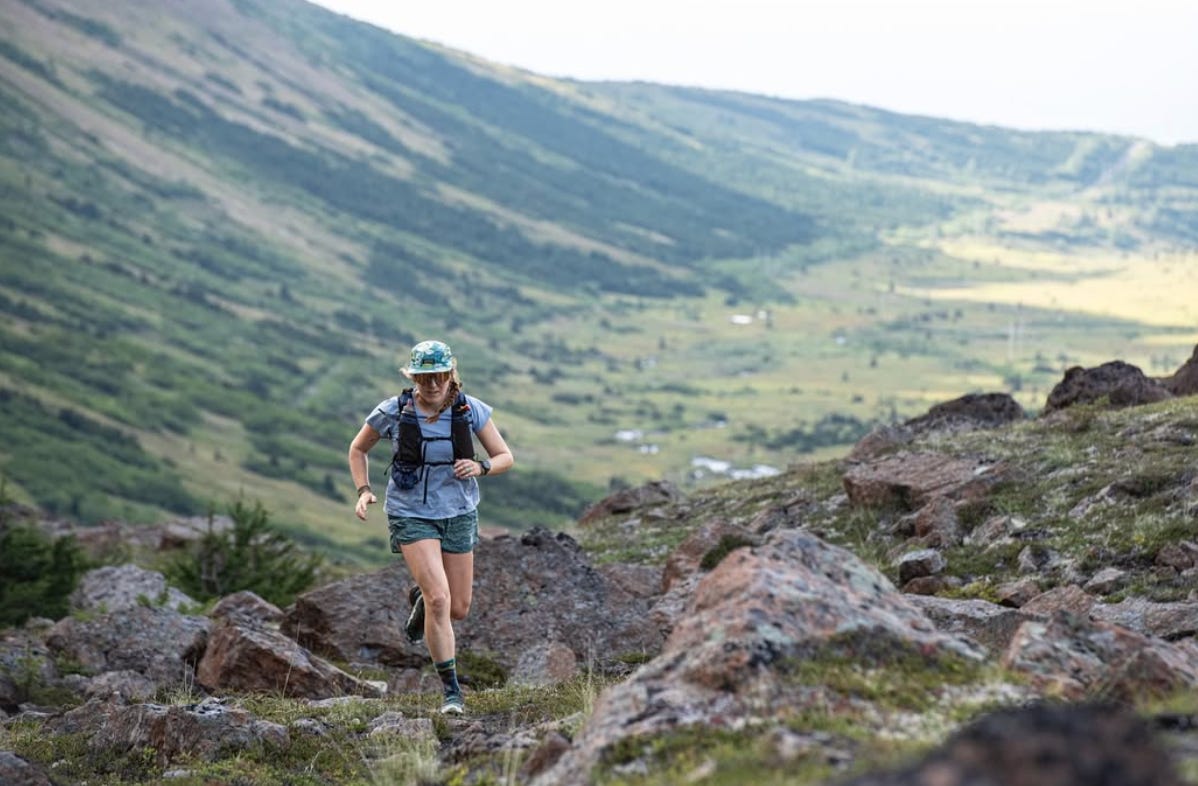
When summer rolls around again, our second in Anchorage, I have a whole new set of trail runs to tick off the list, with the 30-mile K’esugi Ridge Trail in Denali State Park as the ultimate goal. It’s the middle of July and so far I’ve only done a few double-digit runs because of travel and snow lingering up high, and the stress is starting to descend like a low fog.
Nicki has asked me to go dipnetting, and I’ve begrudgingly agreed. Dipnetting is a type of salmon fishing open to Alaska residents in the interest of promoting sustainable subsistence culture. Each July, you can stand in a handful of designated rivers with a large net on a 16-footlong pole and wait for sockeye salmon to swim into it. Residents are allowed up to 25 fish a summer – equal to enough fillets to last most of the year.
I am interested in filling the chest freezer we’ve just bought from Lowe’s, but less interested in spending a day driving all the way out to the Kenai River and then standing in it for hours, waiting for fish to come. My feet feel antsy at the mere thought.
I drive my truck through rutted sand, flooring it to stay moving. We head out to the end of the beach on the south side of the Kenai River where rows of cars, trucks, and campers are already set up. Entire families are here for the weekend. I see elders driving four-wheelers between the shore and their camp spot, 3-year-olds learning how to bash a salmon on the head with a small club to kill them once they’re caught. These weeks of the year, all of Southcentral Alaska pivots toward the Kenai Peninsula. It’s one of the only times there’s actually traffic on the Seward Highway leaving Anchorage.
I pull my dry suit over layers in lieu of waders. It may be July, but it’s Alaska, and I’m about to stand in cold water for a few hours. I tie on old running shoes over the dry suit’s booties, and Nicki and I start hauling our gear – cooler, nets, club, fillet knife – down to the shoreline, where at least 50 people are already standing.
We wade out, feeling the strange sensation of water pressing against our bodies without being wet. I wade out up to my hips, holding the bottom of the net to the riverbed to steady it as the incoming tide rips through. It’s only been a minute or so when I feel a tug on the net. My brain whirs, trying to remember what Joe told me when I picked the nets up from his house.


I twist the net down so both sides of the circular hoop are on the river bottom and start dragging the net toward shore. I can feel the salmon straining against it, trying to wriggle free, but when I pull the net all the way up onto the beach, it is still there.
I realize, a bit dazed, that now I have to kill it. Nicki is still in the water, waiting, and I’m alone on the beach with a fish in one hand and a bright pink club in the other. This is the moment I’ve been most nervous about – the one that requires you to not look away from what it means to eat another creature. It requires you to be connected directly to the process of a fish going from swimming free in the Kenai River to sitting with a lemon slice on your plate.
I’ve expected to feel bad or grossed out or uncomfortable, but somehow, I don’t. I’m calm, dialed in, and grounded. I kneel in the wet sand and club the fish until it stops struggling, then cut out the gills to kill it, letting the blood wash down toward the water. I use the fillet knife to open up the salmon from gills to tail, removing the guts and tossing them back into the river. I set the salmon down on the ice bags in the cooler when I’m done, looking at it in awe. I caught this fish with a net in the river, and I will get to eat it.
I gaze around the beach, looking at the other families gathering this wild and beautiful resource, and feel connected to the river and the salmon and the people around me in a way I hadn’t seen coming. I close the cooler, pick up my net, and walk back toward the water, ready to stand there until the next one comes.


For more about Carolyn and The Full Range visit rmbooks.com